Why Good UX is the New Marketing: My Strategy for Google Play Level Up
If you publish games on Google Play, the Level Up program represents a tangible opportunity to gain more discoverability, better re-engagement, and deeper data.
Google Play Games Level Up: Turning UX Best Practices into Growth Levers
If you publish games on Google Play, the Level Up program represents a tangible opportunity to gain more discoverability, better re-engagement, and deeper data. However, it comes with a "price": it demands a more polished experience—think cloud saves, meaningful achievements, and cross-device support—within a strictly defined roadmap.
As the Co-Founder of Green Sauce Games—and the programmer behind all our titles—I am genuinely excited about this. Why? Because it transforms standard product best practices into direct growth levers within the store itself.
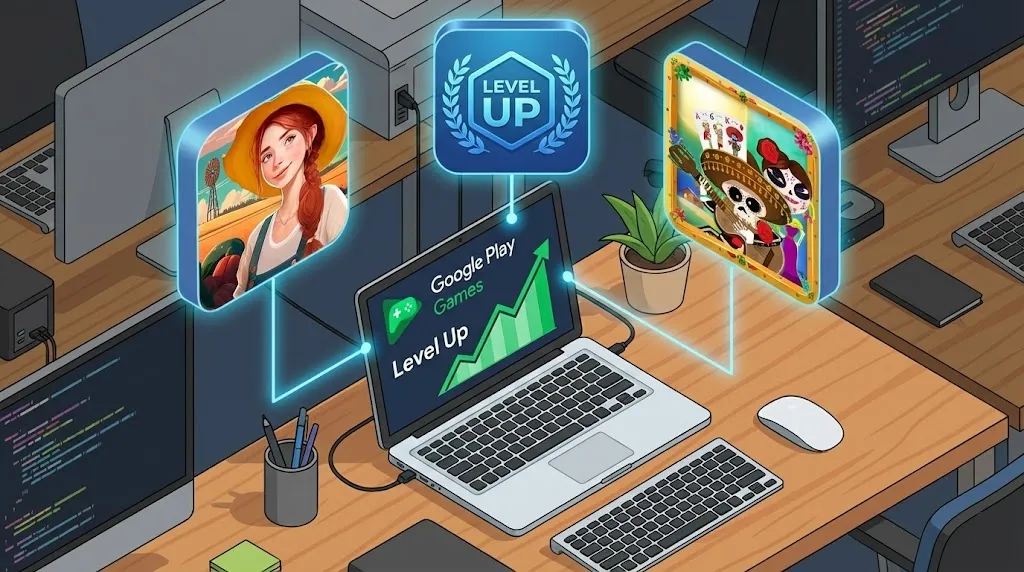
I’ve decided to dive in headfirst. I’m starting the integration process with two of our titles:
- Hope's Farm 2: Our most recent release, which fits perfectly into the modern feature set.
- Day of the Dead Solitaire: A veteran in our portfolio. Despite being older, it still commands a solid download volume and healthy in-app purchase revenue on Android, making it a prime candidate for this kind of optimization.
What is it? (No Fluff)
The Google Play Games Level Up is an open program offering tools and promotional opportunities for developers who deliver a superior experience and adhere to specific UX guidelines.
It was born from a clear vision: Google Play no longer wants to be just a "storefront." It wants to encompass the entire player journey—discovery, gameplay, returning, and being rewarded.
Where it Unlocks Growth
The most obvious (and powerful) piece of this puzzle is the "You" tab in the Play Store. This is a personalized space where players see content and rewards from games they have played recently. It allows you to highlight events, offers, and updates directly to your active users.
This is low-friction re-engagement. Instead of relying solely on push notifications or paid ads, your game appears organically within the player's own "ritual" inside the Play Store.
Another front is Discovery & Editorial. Google is incorporating Level Up UX guidelines into their editorial criteria. Games in the program have a higher chance of receiving boosts and recommendations on high-value surfaces like "Games home" and "Play Points home."
My personal take: I read this as "Good UX = Distribution."
There is also an underrated detail regarding Creative Optimization. Using experimentation and AI on Google Play can drastically impact your CVR (Conversion Rate). There are public case studies showing a +57% increase in conversion in just two months using A/B testing at scale with AI-accelerated assets. Even if you don’t have a massive marketing team, you can treat this as a launch feature: "Let's test icons, screenshots, and messaging as part of the sprint."
The Developer Roadmap (What I’m Doing)
The program is guided by milestones, with the first major checkpoint coming up in July 2026. Here is my "hands-on" execution plan:
- Implement Achievements: I’m designing these to cover the entire lifecycle of the game (progression, mastery, exploration/secrets). This sustains recurrent engagement and acts as a lever for the ecosystem's mechanics.
- Prepare the Play Games Sidekick: This overlay keeps the player in the game while they access content, offers, rewards, and features like Play Points, coupons, or quests.
- Plan for Cloud Save & Seamless Restore (Nov 2026): The goal is to synchronize progress across devices and guarantee a "drama-free" restoration process, linking everything to the player’s Google Play Games profile.
A technical tip: The Sidekick (Beta) is testable via the Play Console using internal/closed testing tracks. There is a configuration path to "add the sidekick to submitted app packages" to validate it before thinking about production. For me, this is perfect—it fits right into a feature flag workflow. I can validate it in an internal track, build confidence, and only then "lock it in" as a roadmap requirement.
Final Thoughts: An Investment, Not Just a Checklist
At first glance, the Level Up program might look like just another set of requirements to tick off. However, I see it as a roadmap to a healthier game ecosystem. By incentivizing us to prioritize features like Cloud Save and friction-less achievements, Google is essentially pushing us to build better, stickier products.
For Green Sauce Games, upgrading Hope's Farm 2 and Day of the Dead Solitaire isn't just about chasing a badge; it's about future-proofing our portfolio. I’m betting that aligning our development roadmap with Play’s growth engines will pay off significantly in long-term retention and visibility.
I’ll be sharing updates here as we hit these milestones and start seeing the data come in. Time to get to work.
More Info

Comments
Have a question, or found an issue with the code? Drop a comment below — I read and reply to every one.